
Best AI Image Generator (2026): 9 Tools Compared Honestly
In short
There is no single best AI image generator in 2026. Here is what each of the big models is actually good at, and how to pick the right one for your work.
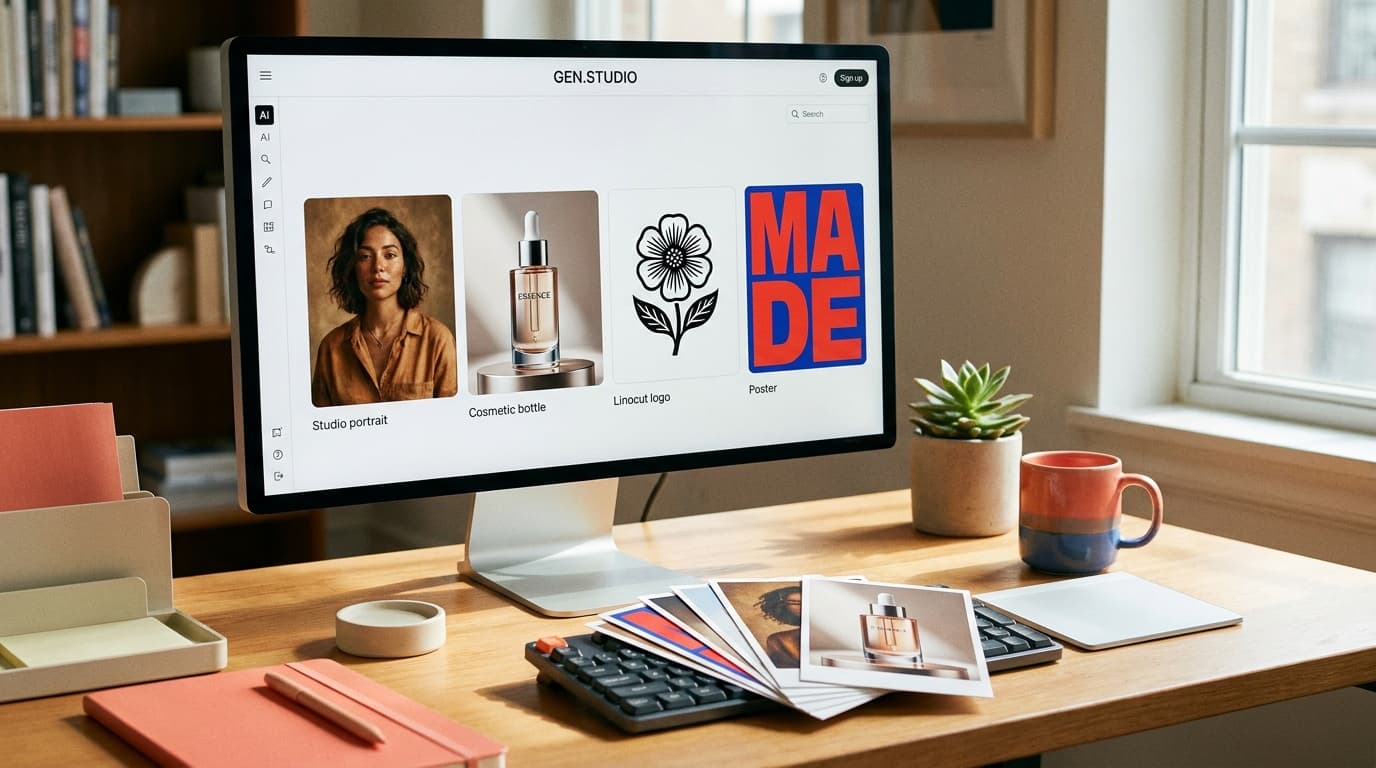
The best AI image generator in 2026 is not one tool. It is whichever model matches the picture in your head: a moody editorial hero shot, a photoreal product mockup, a poster with text that renders correctly, or a clean vector logo. Those are different jobs, and different models win them. I put the nine generators people actually use side by side. One disclosure up front: I help build one of them (Fattly), so weigh my take on it accordingly. I have kept the rest honest and told you where each tool beats the others, including where they beat Fattly.
The short version
- Midjourney — the best pure aesthetics and ad-creative look, full stop. Subscription only, no free tier.
- FLUX — the photorealism workhorse. Open-weight, pay-per-image, and it lives inside almost every other tool.
- Ideogram — the one that actually spells words right. Reach for it when the image contains text.
- Leonardo AI — the all-rounder for game art and concept work, with a genuinely usable free tier.
- Higgsfield — all-in-one image plus video with pro camera controls, sold as one subscription.
- Adobe Firefly — commercially safe by design, and it lives inside Photoshop.
- DALL-E / GPT Image 2 — tops the arena.ai leaderboard and it is already in ChatGPT, so it is the most convenient. Weaker on hard photoreal.
- Recraft — the design tool of the bunch: vectors, brand kits, and reliable text.
- Fattly — many of the models above in one app, pay-per-credit, no subscription. Broad, not a single deep specialty.
How I judged them
I did not rank these on feature-count. For image generation, only a few things actually decide which tool you should open:
- Aesthetic ceiling — at its best, how good does the output look without heavy prompt surgery?
- Photorealism — does skin, light and texture hold up, or does it read as obviously AI?
- Text rendering — can it put readable words on a poster, label or ad?
- Control and iteration — reference images, in-painting, style consistency, character consistency.
- Commercial safety — clear licensing you can defend to a client or a legal team.
- Pricing model — subscription versus pay-per-image matters a lot for solo creators and seasonal work.
No invented benchmark scores here. Where I do not have a hard figure, I keep it qualitative.
The nine at a glance
| Tool | Best for | Pricing model | Where it stands out |
|---|---|---|---|
| Midjourney | Aesthetic hero shots, ad creative | Subscription (no free tier) | Best-looking output out of the box |
| FLUX | Photoreal images at scale | Pay-per-image / open-weight | Realism, and it runs everywhere |
| Ideogram | Images with text | Free tier + paid | Accurate typography in-image |
| Leonardo AI | Game art, concept, all-round | Free tier (~150 tokens/day) + paid | Control, training, Teams |
| Higgsfield | Image + video together | Subscription | Many models, cinematic controls |
| Adobe Firefly | Commercially safe, Photoshop | Subscription / credits | Licensing you can defend |
| DALL-E / GPT Image 2 | Quick images inside ChatGPT | In ChatGPT subscription | #1 on arena.ai, prompt understanding |
| Recraft | Vectors, logos, brand design | Free tier + paid | SVG output and text |
| Fattly | Many models in one app | Pay-per-credit (no subscription) | Model access without stacking subs |
Midjourney
If you judge these on raw good looks, Midjourney still wins. Version 8.1 produces the most striking, editorial, ready-for-a-campaign images with the least effort — now at 2048×2048 by default — and that is why art directors and ad creatives keep paying for it. The aesthetic default is simply better than anyone else's.
The trade-offs are real, though. There is no free tier, so you cannot try it without a subscription. Text rendering has improved but is not its strength, and precise control (exact composition, product accuracy, a specific logo in frame) is harder than in tools built around reference images. It is the artist, not the technician.
Best for: anyone who needs the best-looking image and cares more about mood than pixel-exact control. Pricing: subscription only.
FLUX
FLUX, from Black Forest Labs, is the photorealism engine of the current generation. FLUX.2 produces convincing skin, lighting and texture at up to four megapixels, and because FLUX is open-weight, you will find it powering features inside a dozen other apps and platforms. That ubiquity is a feature: you rarely pay Midjourney-style subscription prices for it, and pay-per-image runs cheap, roughly a few cents per generation.
The catch is that FLUX is a model, not a polished consumer product. On its own it gives you less of the guided, click-to-refine workflow that Leonardo or Recraft build around you, so you get the most from it inside a tool that wraps it in real controls.
Best for: photoreal images, product shots, and anyone who wants realism without a monthly commitment. Pricing: pay-per-image (open-weight).
Ideogram
Ideogram solves the one problem that used to embarrass every image model: text. Its v3 renders words in-image with high accuracy, so posters, ad headlines, packaging labels and quote graphics come out readable instead of as garbled AI-alphabet soup. If your image needs to say something, this is the specialist.
It is not trying to out-aesthetic Midjourney on a wordless portrait, and it does not need to. There is a free tier to test the typography before you commit, which is exactly how you should evaluate it: give it a real headline and see if it holds.
Best for: anything with text in the frame, from social graphics to mockups. Pricing: free tier plus paid plans.
Leonardo AI
Leonardo is the tool people mean when they say "Midjourney alternative." It is an all-rounder built for game assets, concept art and production workflows, with its own Phoenix and Lucid models, custom model training, and a Teams tier for studios. Crucially, it has a real free tier, around 150 tokens a day, so you can work daily without paying, which almost nobody else on this list offers.
Where it shines is control and iteration: reference images, consistent characters, fine-tuning to a house style. The aesthetic default is very good but not quite Midjourney's out-of-the-box magic. You trade a little polish for a lot more steering.
Best for: game and concept artists, and anyone who wants control plus a free daily allowance. Pricing: generous free tier, paid plans and Teams.
Higgsfield
Higgsfield is the other all-in-one on this list, and it leans hard into combining image and video in one place. It gives you access to multiple heavy models (FLUX.2, Kling, Veo, Sora-class video) behind one subscription, with strong cinematic and camera controls that make it a favorite for motion-minded creators.
The honest framing: it overlaps with Fattly on the "many models, one place" idea, but it is sold as a subscription and skews toward video-first, cinematic use. If your work is mostly moving images and you want pro controls bundled, it is a strong pick. If you want single images and dislike monthly fees, it is a heavier commitment than you need.
Best for: creators who want image and cinematic video models bundled together. Pricing: subscription.
Adobe Firefly
Firefly's pitch is not "the best-looking image." It is "the image you can safely use for work." Adobe trained it on licensed and public-domain data and offers commercial-use terms, which matters enormously if a client or a legal team is going to ask where the picture came from. It is also built into Photoshop and the wider Creative Cloud, so generative fill and expand sit right next to the tools designers already use.
On pure output quality it is competitive rather than category-leading, and you are inside the Adobe pricing and ecosystem. But for regulated, brand-sensitive or agency work, the licensing peace of mind is the whole point.
Best for: commercial work where licensing and Adobe integration matter more than the last 10% of aesthetics. Pricing: subscription and credit-based within Creative Cloud.
DALL-E / GPT Image 2
The reason DALL-E, now GPT Image 2, matters is not only convenience — it currently tops the arena.ai text-to-image leaderboard, and it is already inside ChatGPT, so hundreds of millions of people can make an image mid-conversation with no new tool to learn. Its prompt understanding is excellent, and it is genuinely great for quick concepts, mockups and illustrative images where that convenience wins.
Where it falls behind is hard photorealism and the fine, art-directed control the specialists offer. It is the tool you reach for because it is right there, not because it beats FLUX on realism or Midjourney on mood.
Best for: fast, convenient images for people already living in ChatGPT. Pricing: included in a ChatGPT subscription.
Recraft
Recraft is the odd one out, in a good way: it is the design tool of the group. It generates true vector art and SVGs, keeps a consistent brand style across a set, and renders text reliably, which makes it the pick for logos, icons, illustrations and brand systems rather than photoreal scenes. A vector logo you can scale to a billboard is a different deliverable from a photoreal portrait, and Recraft is built for the former.
If you want moody photography, this is not it. If you want a clean, editable, on-brand asset kit, few tools come close.
Best for: designers, logos, icons and vector brand work. Pricing: free tier plus paid plans.
Fattly (my disclosure applies here)
Fattly's angle is not "we made a better model than Midjourney." We did not, and I would not claim it. Its angle is access: it puts 50+ AI models in one app, including several of the names above — Nano Banana (Google's Gemini image model; Nano Banana 2 and the 4096-pixel Nano Banana Pro that many now rate the best all-round generator for realism and accuracy), plus FLUX.2, Ideogram, Recraft and more — so you can pick the right model per job instead of subscribing to four different tools. Two things make it different in practice. There is no subscription (you pay per credit, and credits never expire), and it ships an API, CLI and MCP server so teams and AI agents can generate programmatically. You can test it on 10 free credits without a card, in English, Polish, German or Spanish.
Being honest about the limits: on pure aesthetics for a single hero image, Midjourney will usually edge it, because Fattly is routing to underlying models rather than inventing a better one. For pure photorealism, though, the Nano Banana and FLUX.2 models it routes to are genuinely top-tier. Where it wins is when you would otherwise juggle FLUX for realism, Ideogram for text, Recraft for vectors and something else for edits, each with its own login and bill. Fattly puts all of that behind one credit balance and no monthly fee.
Best for: people who want model choice and pay-per-use pricing without stacking subscriptions. Pricing: pay-per-credit, no subscription, credits never expire.
Budget and free options
Two more worth naming if cost is the deciding factor. NightCafe is a long-running community tool with free daily credits and access to several models, good for hobbyists and experimenting. Playground offers a capable free tier aimed at social graphics and general images. Neither leads on top-end quality, but both let you generate without a card, which is the point when you are just starting out.
How to actually pick
Match the tool to the picture you need, not to the longest feature list:
- Best-looking, art-directed hero image or ad creative → Midjourney
- Photorealism, product shots, cheap per-image cost → FLUX
- The image contains text (poster, label, headline) → Ideogram
- Game art, concept work, control plus a free daily tier → Leonardo AI
- Image and cinematic video bundled together → Higgsfield
- Commercially safe licensing and Photoshop → Adobe Firefly
- Quick images without leaving ChatGPT → DALL-E / GPT Image
- Logos, icons, vectors, brand systems → Recraft
- Many of these models in one app, no subscription → Fattly
- Free experimenting, no card → NightCafe or Playground
Frequently asked questions
Which AI image generator is best in 2026?
There is no single winner, because the tools specialize. On raw leaderboards, GPT Image 2 and Google's Nano Banana 2 currently top the charts for all-round quality and realism. But Midjourney still leads on aesthetics and ad-creative looks, FLUX.2 on open photorealism, Ideogram on text-in-image, Recraft on vectors and logos, Leonardo on game and concept art, and Firefly on commercially safe licensing. Pick by the job in front of you, not by a single leaderboard.
What is the best free AI image generator?
Leonardo AI has one of the strongest free tiers (around 150 tokens a day) for daily creative work, and Ideogram's free tier is the best way to test text rendering. NightCafe and Playground both let you generate without a card. Fattly gives 10 free credits with no card if you want to try several models in one place before deciding.
Which AI image tool is best for text inside the image?
Ideogram v3 is the specialist here, with strong accuracy on words in posters, labels and ad headlines. Recraft is the other strong option, especially when the text needs to sit inside a designed, on-brand layout or a vector graphic rather than a photoreal scene.
Is Midjourney or Leonardo better?
They are aimed at different users. Midjourney gives the best out-of-the-box aesthetics but is subscription-only with no free tier and less granular control. Leonardo gives you more control, custom training, a Teams tier and a real free allowance, at a small cost to raw polish. Want the prettiest single image, choose Midjourney; want control and a free daily quota, choose Leonardo.
Ready to try?
Try Fattly's AI image generator